It's rare that I buy
something worth more than £20 on impulse. At Doncaster I'd
originally intended to buy a Branchlines 0-4-0 Chassis Replacement
Kit for one of my Hornby Pugs, but failing to find a Branchlines
stand at the event, I decided to pursue other review material
instead. It'll have to wait 'till London, but Desmond will get his
new chassis yet!
.JPG) |
| But for now, more puggish pugs! |
This Pug is a
distinct exception, it's dumb buffers, tiny boiler and plates over
the slide rods making a unique specimen among tank engines. Costing
around £50, it's damn cheap, too – many points will cost
you more than this! For that shellout you get an exceptionally
compact locomotive ideal for the most compressed of micro layouts,
the dumb buffers and truncated wheelbase making it a dyed-in-the-wool
dock tank.
.JPG) |
| For such a cheap model, details are abound |
I can only assume
this locomotive is of 2010 production, since lettering is crisp and
accurately positioned. The details don't stop there, either, there
are many accurately moulded auxiliary parts and separately-fitted
handrails, rivets are plentiful enough to make a convincing
impression; even the plates over the slide-bars are well done, giving
further charm to this already charismatic model.
Upon unboxing you
get a very simple spread: The Pug, a man pointing, 4 lamps each of both LMS and BR design, and 4 indicator discs. Okay, I'm being facetious, the pointing man is
the driver according to the excellent service manual, and his arm is
intended to partially cover the motor; kind of like the set models of
the old Thomas the Tank Engine TV series which had model drivers with
pose-able arms. Getting him into the cab to position him couldn't be
easier since the cab simply clips onto the chassis, a neat
arrangement that saves a lot of screw trouble when running in.
 |
| It's rare that the instructions for budget things are this good |
Speaking of screw
trouble, my example came with the motor screwed in too tightly,
causing the motor to lock up – a condition known as “stall”,
and it's infamous in the R/C world for burning motors out or even
starting fires in extreme cases! It should be said at this point that a
tight gear-train is never a good thing, even if it runs; over time,
the gears will be ruined. Thankfully there's only one screw holding
the motor on, so it's a question of undoing the motor just enough to
make it turn freely.
 |
| It may look loose, but it's infinitely preferable to a burnt-out motor |
 |
| Me and my testing, you and your shed… So pipe down, you... |
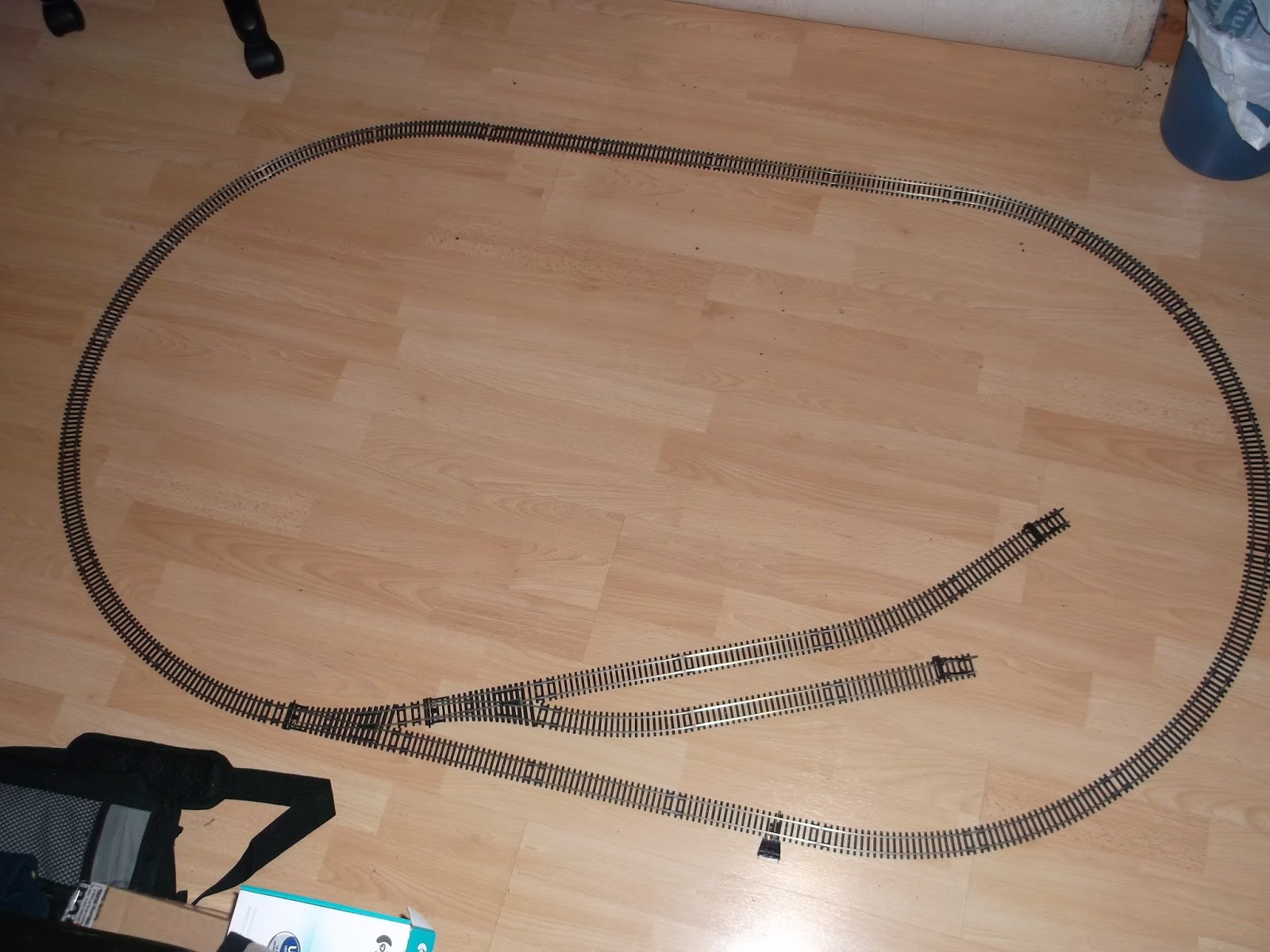
My test circuit is
very rudimentary at present, since I've yet to build a layout
(Folding Test Track? Hmm...), thus I'm using a hornby trainset with
two track packs installed to test point operation. It should be
noted that I presently lack DCC equipment, so I can only test the
loco using a standard hornby DC controller from the trainset (nothing
but the best at this house!). I'll be sure to add a corollary post
once this situation is seen to.
 |
| I need a Gaugemaster DC unit at the very least, but it'll do I suppose |
Once it is adjusted
and run in, the 75g pug gives an amusing sight at full speed, as it's
chihuahua wheels whirr and whizz whilst producing not all that much
speed. Is this a deal breaker? Maybe for some children (I reckon
Smokey Joe is an icon because
of his Scalextric swiftness!), but for those who want a yard pilot,
it's a glowing sign. The Pug delivers; it
is adept at low-speed maneuvers even on DC power, although maybe not
quite as glacial as DCC should make it capable of.
Trouble
reared it's ugly head once points were encoutered, however. The
0-4-0 curse struck again with the train-set's insulfrog points,
making low-speed shunting particularly perilous. Again,
DCC can probably come to the rescue here, along with electrofrog
pointwork. Those who stuck with insulfrogs should be prepared to
reason that their driver is under training to explain the lurches
necessary to prevent stalling, failing that the humiliating intervention of
the “hand-of-god”. One
saving grace is that the momentum of heavier wagons does help to keep
the pug going through these momentary lapses of power, though you
can't rely on that all the time.
Enough
about how it runs by itself – an engine is useless with nothing in
tow. Let us delve into it's pulling power, it's all important
Tractive Effort. I have here a line-up of suitable wagons for
testing:
|
Rolling Stock |
Weight |
|
Hornby L&Y Pug |
75g |
|
Lima Mk1 RBR |
135g |
|
Tri-ang Mk1 FK |
100g |
|
Tri-ang Mk1 BSK |
100g |
|
Hornby 4-Wheeler |
45g |
|
Hornby 7-up 7-plank Wagon |
25g |
|
Hornby Pepsi Tank Wagon |
35g |
|
Hornby Tango Box Van |
35g |
In pulling tests, we
were greeted with a sad, but not entirely unexpected sight. The
usual 3 carriage Mk1 rake I use to test new locomotives (Tri-ang Mk1
FK, Lima Mk1 RBR, Tri-ang Mk1 BSK; 335g in total) proved too much to
even start; the two Tri-ang Mk1s (200g total) can be started
carefully, but do show wheelslip under acceleration. Replace one
Tri-ang Mk1 with the heavier Lima (235g total), and wheelslip is
inevitable when starting. On the plus side, the Product Placement
Train (Hornby 7-up, Pepsi and Tango wagons; 95g total), as well as a
trio of 4-Wheelers (135g total) can be pulled without a hint of
drama. Those who'd like to model a small preserved line not unlike
the South Devon Railway or the Lavender Line will not be let down.
 |
| Childhood... |
 |
| Branch Passenger, anyone? |
 |
| You can't tell in a still image, but the pug is whirring away without result |
All in all, I cannot
recommend more than 200g with this loco in any case, much less when
hills are involved. Then again, the pug was never expected to handle
more wagons than can be counted on one hand, the real pug in
preservation slips when pulling two wagons and a brake van:
The final thing I
ought to mention is the couplers – don't get me wrong, they work
just as well as you can expect any tension lock produced by Hornby,
but this is a 2010 model, right? NEM Pockets? Surely these made it
into 2010? Given the attentive detail on the model itself, it seems
really out of place to omit these ever-versatile sockets; probably
the one innovation of our time that did more to solve operational
issues than any other, besides DCC. Maybe it won't be too hard to
retrofit them, and with a £50 model not much capital is at
stake, but it's a very simple yet curious oversight.
 |
| Those big hideous hoops characteristic of train sets... |
If you want to know the exact procedure of my review scores, check
back with the Maplin Pin Vice Review for a full summation. I
shall now pass judgement upon this humble saddle tank:
Detail 5/6
Stellar for the money. Granted, it's only a little tank engine
smaller than many trucks, but this isn't just the Dapol kit – this
is the real deal with motor, couplings and details.
Quality 5/6
Another great score. I keep coming back to the money thing, but it
is rather excellent that you can have a proper enthusiast's
locomotive for just double the price of the standard Hornby 0-4-0.
Function 4/5
For precisely what it's designed for, shunting a handful of small
wagons around curves almost too tight for them, it's ace! Maybe
it'll be of limited use when carriages come into play, but if you've
got the preservation scene in mind, you'll probably need another pug
of some kind to double-head anyway.
Value 3/3
As I've said before, this is easily the cheapest way to get a proper
enthusiast-grade locomotive. Not only is it detailed but it also
runs well and slow. Ideal starter locomotive for getting into
weathering or practicing fitment of DCC decoders to old stock.
Overall 17/20
When I found this little gem, only the wheel configuration reassured
me that this wasn't another slot-car pug. I don't really know why I
feared those tiny wheels could somehow propel it to warp-speed, but
there are way too many scalextric-derived 0-4-0s on the market for me
to feel safe.
Rest assured I feel safe now. This is an ideal locomotive for those
who want a high-standard starting base for their first
kit-bashing/Shapeways project – speaking of which, isn't there a
couple of Peckett Saddle Tanks with roughly the same wheelbase out
there? Perhaps we could gloss over the Dartmoor Gauge and
Immortalize them in OO?